About
Carlos Gussenhoven
Radboud University, Netherlands

Main areas of research
- Phonetics
- Phonology
- Intonation
- Limburgish
- Tone Languages
Bio
Language prosody has been the focus of my teaching and research. My 1984 dissertation On the Grammar and Semantics of Sentence Accents (Foris/Walter de Gruyter), contained nine chapters, eight of which were also published elsewhere. My colleagues and myself have adopted a typological perspective and have published experimenal research on tonal dialects of Limburgish (1999, Netherlands and Germany), showing how lexical tone is integrated in their intonation systems, Yucatec Maya (2006, Mexico), showing that the language does not express focus prosodically, Nubi (2006, Uganda), showing it has tonal rules that in part mimic the word and sentence prosody of Arabic (2006), Zwara Berber (2018, Libya), showing that unlike Moroccan varieties it has word stress (2017), Zhumadian Mandarin (2020, China), showing that question vs statement intonation is expressed paralinguistically, and Cantonese (2024, China), showing that the same contrast is expressed linguistically. I worked at Radboud University (twice), UC Berkeley, Queen Mary University, Nanjing University and the National Yang Ming Chiao Tung University, besides studying and working at Stanford University, UC Berkeley and the University of Konstanz. I am a Fulbright scholar, with life memberships of Laboratory Phonology, IPA and Academia Europaea, and currently an emeritus professor at Radboud University.
Publications:
Wang, L., Ven, M.A.M. van de & Gussenhoven, C. (2025). Dipping and Falling as competing strategies for maintaining the distinctiveness of the low tone in the four-tone system of Kaifeng Mandarin. Journal of Phonetics, 109:101391. doi: 10.1016/j.wocn.2025.101391
Yang, Y., Gussenhoven, C., Reshetnikova, V. & Ven, M.A.M. van de (2024). Functional and phonetic determinants of categorical perception in two varieties of Chinese. In Y. Chen, A. Chen & A. Arvanati (Eds.), Proceedings of the 12th International Conference on Speech Prosody (pp. 642-646)
Keynote Lecture
Dissecting language prosody
The prersence and nature of prosodic structures in languages has proved to be a persistent problem in language description and by extension in language typology. There are three broad issues. The first concerns the dividing line between paralinguistic and linguistic intonation. Among those who recognize the distinction, there are often doubts about the existence of a clear cut-off point as opposed to a grey zone in which the dividing line is more fuzzy. The second issue concerns reports of word stress in languages which phonetic research has recently identified as not having word stress. A common source of such ‘stress ghosting’, to use a term introduced by Marija Tabain and colleagues, is an illusory perception of stress by speakers of languages with stress. A third issue concerns the presence of tone contrasts that are hard to hear for speakers of atonal languages. This less common problem may arise in the description of New Englishes with tonal substrates. In all cases, solutions should be sought in experimental research.
First, a categorical perception experiment involving an identification and a discrimination task will illustrate the experimental approach towards determining the paralinguistic or linguistic status of intonation. A Cantonese and a Mandarin group of speakers responded to lexical and intonational contrasts in their own language to establish to what extent their results would reflect the functional status of monosyllabic pitch contours. Each group was presented with stimuli that came either from continua between lexical tones or from continua between interrogative and declarative intonations of a single tone. The results for Mandarin showed that lexical tone contrasts were perceived discretely and the intonational contrast gradiently. However, in Cantonese both lexical tone contrasts and the intonation contrast were perceived discretely. On the basis of these results, it would appear that intonation contrasts that are expressed through pitch height variation can be or are gradient, while intonation contrasts expressed through pitch shape differences and all lexical contrasts are discrete.
Second, phonetic measurements of variables that have been related to speech effort, like duration and spectral tilt, yielded no evidence for word stress in Ambon Malay, a language that had been described as having regular penultimate word stress, with exceptional final stress. Part of the explanation of the attribution of word stress to languages that do not have it lies in the obligatory nature of stress. A speaker of a language with stress cannot pronounce a polysyllabic word without assigning main stress to one of its syllables. Subtle timing differences of intonational pitch peaks in Ambon Malay must have caused Ambon to be described as having penunultimate stress, but tamang ‘friend’ as having final stress by the linguistist. Earlier perception research had led Rob Goedemans and Ellen van Zanten to conclude that Indonesian has a melodic structure at phrasal boundaries as opposed to word boundaries.or syllables.
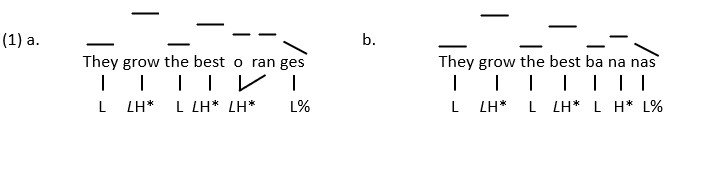
Similar reports of Nigerian English words are responsible for pervasive claims of rightward stress shifts from their position in British English. As a result, contact, helicopter and short track are described as having main stress on tact, copter and track respectively. This description only makes sense if Nigerian English is taken to be a foreign-accented version of British English. However, Educated Nigerian English is a highly standardized variety of English in its own right, most strikingly so for its prosodic features. By not treating it as an autonomous language, whatever prosodic features there are wil run the risk of being overlooked. Our third issue is illustrated by perceptual research that showed that the language has two prosodic word types. One type has a High tone on the first syllable and the other has a H tone on the second. In both cases, H is preceded by a Low tone, which triggers downstep on H when the word occurs after another major-class word in the intonation phrase. The (downstepped) H spreads through the word. If the above examples are utterance-final, they will end with an intonational L% boundary tone which creates a fall in pitch that speakers of British English may hear as final stress. The sentences in (1) illustrate the Nigerian English contrast in their last words. The italic L is unassocated, for lack of a free syllable. In (1a) the pitch of the first syllable of oranges contrasts with lower pitch on the first syllable of bananas. Function words have L.